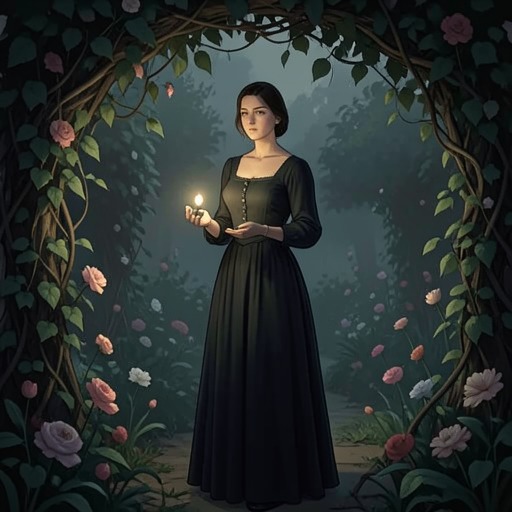
Tündérfa
Csongor és TündeTündérfa is a solitary flowering tree that joins the story’s enchanted landscape to the history of love between a fairy maiden and the mortal world. Its silver flower and shining jewel make it a marvel in its own right, while the recollections attached to the tree give it a second function: it marks the place where love was first planted and where its consequences can later be recognized.
Appearance and First Encounter
At the opening of the play, Tündérfa stands alone in a garden, flowering at its center. Beneath it, Mirígy sits bound, and Csongor arrives. The staging brings the tree, its captive, and the arriving seeker into one tableau: before the tree’s history is explained, it is already the fixed point around which confinement, encounter, and discovery gather.
The tree’s blossom is described as silver, with a jewel shining within it. This unusual combination makes the tree more than a natural ornament: its visible beauty conceals a precious, radiant center. The detail also gives the tree a memorable physical identity that can be recalled and interpreted as characters disclose what it means.
The Tree’s History
Mirígy’s account turns the image into a piece of evidence. She says that a beautiful fairy maiden came from this place and may have planted the tree. Her wording preserves uncertainty about the planting, but it firmly connects the tree with the maiden and with the history that Csongor is trying to understand. Tündérfa thus carries a story older than the present encounter, even as the account leaves one detail unresolved.
Much later, Tünde returns to the landscape and recognizes it as the place where she first wandered and planted love. Her recollection gives the earlier suggestion a more intimate dimension: the tree is not simply a marvel associated with a fairy maiden, but a marker of the beginning of love. The movement from Mirígy’s conjecture to Tünde’s personal recognition changes the tree’s significance from reported origin to remembered experience.
Memory, Love, and Recognition
The tree links separate moments in the play without erasing their distance. In the opening garden it is present beneath Mirígy, who speaks of the maiden who may have planted it; later, Tünde identifies the landscape as the place where love began. The recurrence makes the setting a material record of a relationship: characters can leave the place, but its distinctive tree remains available for recognition.
Its silver blossom and inner jewel sharpen that role. What first appears as extraordinary beauty becomes associated with a humanly consequential beginning, so that the tree’s value is at once visible and remembered. Tündérfa holds together natural image, supernatural wonder, and personal history; its importance lies not only in what it looks like, but in what the returning landscape allows Tünde to recall.